Do Race Suits Expire? SFI Recertification Explained
Yes — race suits expire, but it’s the certification that runs out, not the fabric overnight. An SFI 3.2A suit carries a dated tag, and most sanctioning bodies expect a re-certification roughly every 5 years — the suit goes back to an SFI-recognized facility for inspection and a fresh tag. An FIA 8856 suit goes further and prints an actual expiry date, generally 10 years from manufacture. Either way, a tech inspector reads the tag — and an out-of-date tag can be rejected at the gate.
This guide explains why SFI requires recertification, the exact 5-year timeline, how to read the tag date, what recertification involves and costs, the signs a suit is unsafe, and how it all applies to a new custom suit built to your design.
- SFI 3.2A → ~5-year recert window from the tag date
- FIA 8856 → printed 10-year expiry on the label
- An expired tag fails tech — even on a clean suit
~5-Year Window
SFI 3.2A recert cycle
Read the Tag
Date is sewn in
FIA Prints Expiry
~10 years stamped
Tech Checks It
Expired = rejected
Why SFI requires recertification
Recertification exists because a fire suit’s protection is earned by the condition of its fabric, and condition changes with use. Nomex® doesn’t simply rot on a shelf — but washing, sweat, UV, fuel, heat and ordinary wear all chip away at the shell, the air gaps and the seams that buy you seconds in a fire.
The dated tag is SFI’s way of forcing a periodic re-check: the suit you raced in two years ago is not necessarily the suit you have today. Thinning panels, contaminated fabric, a tired zipper or melted thread can drop a once-rated suit below its number — so the rating is re-verified, not assumed for life.
What is Nomex →Fabric degrades
UV, sweat, heat and repeated washing thin the Nomex® shell and weaken the trapped air gaps that slow heat.
Contamination spreads
Oil, fuel and grease soak in over a season and can make a panel flammable — the opposite of what the suit is for.
Seams & closures wear
Pulled stitches, frayed Nomex® thread and a sticking zipper are structural failures a fresh inspection catches.
The SFI recertification timeline
The SFI clock starts on the date sewn into the tag and runs roughly five years before most series want a re-certification. Here’s the lifecycle from a brand-new suit to an out-of-window one, then a validity table by standard.
New & certified
The suit ships with a dated SFI 3.2A tag. The clock starts the day on the tag, not the day you buy it second-hand.
In the window
Tech-legal at most SFI series. Wash and store it right and the certification simply rides out its window.
Recert due
Most sanctioning bodies want a re-certification around the five-year mark — the suit goes back for inspection and a fresh tag.
Out of window
An expired tag can be rejected at tech, even if the suit looks new. Recertify or replace before the next event.
| Standard | What the date means | Typical validity | What tech checks |
|---|---|---|---|
| SFI 3.2A | Sewn-in tag with a certification / manufacture date | ~5 years to re-cert | Tech reads the tag date against the rulebook window |
| SFI 3.4 / 3.3 | Same dated-tag system on accessories (gloves, shoes) | ~5 years to re-cert | Each item carries its own dated SFI tag |
| FIA 8856-2000 | Homologation label with a printed expiry date | 10 years from manufacture | Inspector reads the printed FIA expiry on the label |
| FIA 8856-2018 | Homologation label with a printed expiry date | 10 years from manufacture | Inspector reads the printed FIA expiry on the label |
Windows are typical — the binding rule is whatever your series rulebook prints. SFI ratings explained →
How to read the SFI tag date
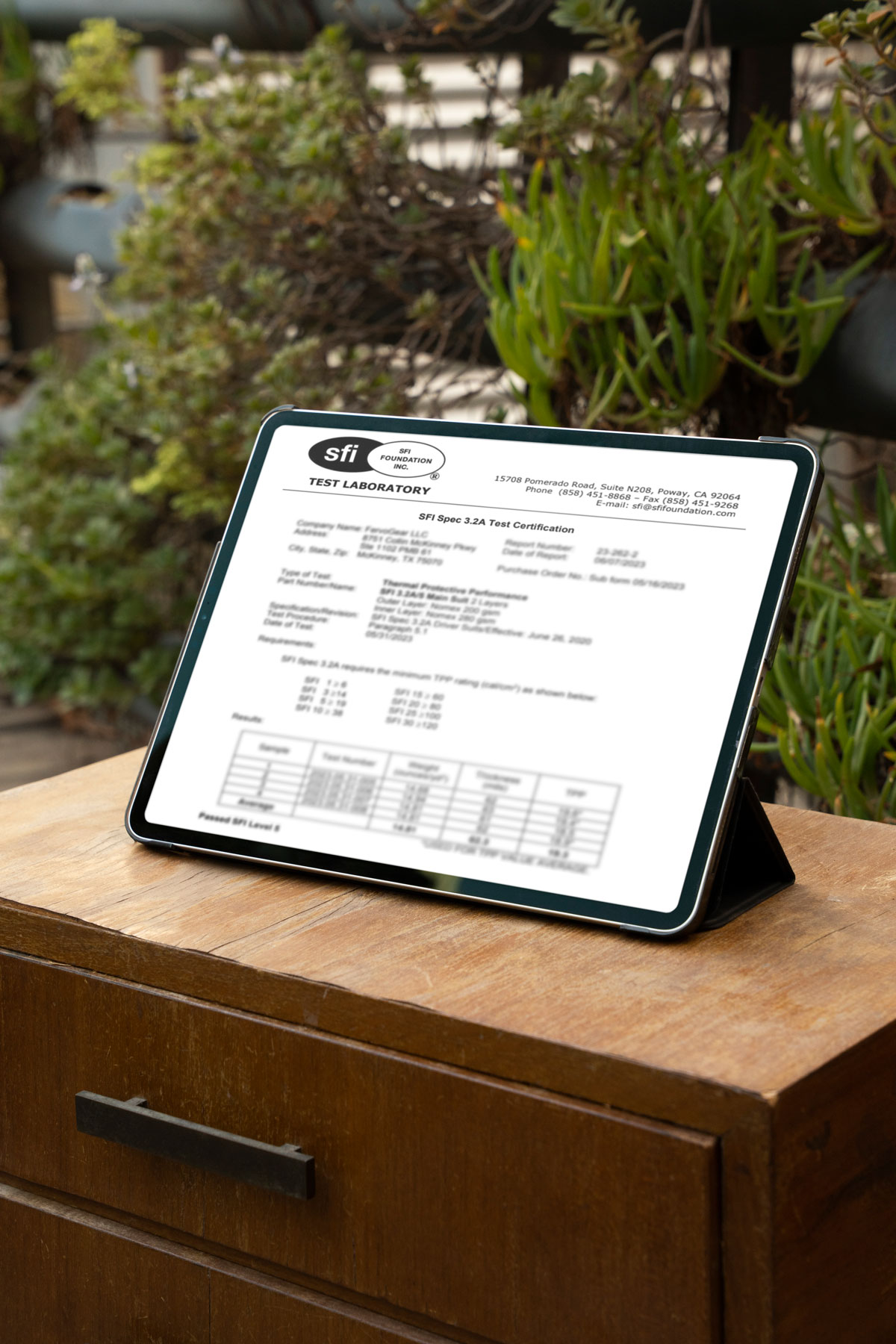
The date that controls expiry is printed on the sewn-in certification label — find it before you assume a suit is legal. On an SFI suit the tag is usually inside the collar, on the inner left chest, or beside the main zipper. It shows the spec (SFI 3.2A), the rating (e.g. 3.2A/5) and a certification or manufacture date — that date starts the recert clock.
On an FIA suit, the 8856 homologation label prints a homologation number and an explicit expiry date you read directly. If the tag is missing, illegible or cut out, treat the suit as un-verifiable — tech can refuse it on that alone, no matter the condition.
How to measure for a race suit →What recertification involves & what it costs
Recertification is an inspection and re-tag at an SFI-recognized facility — not a wash and a new sticker. A technician verifies the whole garment still performs, then either re-tags it or condemns it.
Send to an SFI-recognized facility
Recertification isn’t a home job. The suit goes to a facility recognized by the SFI Foundation that can inspect and re-tag against the 3.2A spec — not just any seamstress or dry-cleaner.
Full garment inspection
A technician checks the Nomex® shell, seams, the main zipper, cuffs and collar for charring, thinning, contamination, melted thread or damaged closures — anything that would let heat through.
Re-test or condemn
A clean, sound suit is re-certified and gets a fresh dated tag. A suit with fire damage, oil-soaked fabric or failing seams is condemned — no tag, because it can’t be trusted in a fire.
Cost vs. a new build
Recertification typically runs a fraction of a new suit, but on an old or damaged garment the math often favors replacing it with a new certified build — especially a custom one cut to your current measurements.
Recert is cheaper than a new suit — but only worth it on a sound, undamaged garment.
Signs your suit is unsafe
A suit can be inside its date and still be unsafe — condition overrides the calendar. These are the failures that condemn a suit at inspection, or should retire it before you ever reach tech.
Char, scorch or melted fibers
Any burnt, glazed or melted area means the Nomex® has already taken heat once. Its protective margin is spent there — a fire-damaged suit is retired, not recertified.
Oil, fuel or grease soak-in
Petroleum contamination is flammable and washing rarely lifts it fully. A fuel- or oil-soaked panel can ignite — heavy staining condemns a suit even inside its date.
Thinning, pilling or worn panels
Fabric that’s gone thin, fuzzy or translucent at the knees, seat or elbows has lost layer integrity — the air gap that buys you seconds is no longer doing its job.
Failing seams or zipper
Pulled stitches, a Nomex® thread that’s frayed, or a zipper that sticks or won’t fully close are structural failures — a suit is only as protective as its weakest seam.
Expired or missing tag
No readable SFI tag, or a date past your series’ window, means tech can refuse it at the gate regardless of condition. Recertify to get a fresh, verifiable tag.
Shrinkage or stiffening
A suit that’s shrunk, gone board-stiff or smells scorched has likely seen heat or a hot dryer — both degrade the fiber and the fit that keeps coverage intact.
When in doubt, get it inspected — a fire suit only has to fail once.
How to extend a suit’s life
You can’t move the tag date, but how you wash and store a suit decides whether it reaches its recert window still able to pass. The fastest way to age a Nomex® suit is bad laundering — hot water, bleach, fabric softener, dry-cleaning, a hot dryer or drying in direct sun all degrade the fiber and can shrink or stiffen the fabric.
The right routine is simple: wash cold with a mild, non-bleach detergent, turn it inside out and zip it closed, run a gentle cycle, then hang-dry out of sunlight. Keep it off petroleum, store it on a wide hanger out of UV, and a well-kept suit usually sails through recertification.
How to wash a Nomex race suit →When to replace vs recertify
Recertify a sound suit whose only problem is an expired tag; replace any suit whose fabric, fit or cleanliness has failed. This map matches the most common conditions to a verdict.
| Condition | Verdict | Why |
|---|---|---|
| Tag expired · suit clean & sound | Recertify | No fire damage, no contamination, seams and zipper good — the cheapest path is inspection and a fresh tag. |
| Char, melt or scorch anywhere | Replace | Heat-damaged Nomex® can’t be restored. Retire it and build new — a fire-exposed suit will not pass and shouldn’t. |
| Oil / fuel soaked in | Replace | Flammable contamination you can’t wash out fails the whole purpose of the suit. Replace rather than risk it. |
| Thin, worn or wrong-fitting | Replace | Lost layer integrity or a fit that’s changed means the protection math no longer holds — a new custom build is the answer. |
The deciding factor is never the calendar alone — it’s whether the suit can still do its job in a fire.
Replace when the math tips
On an older suit, the cost of recertification plus shipping — on a garment that may still fail — often beats out a new build that resets the full window. A new custom suit also fixes a fit that’s changed, which an inspection never can.
If the suit shows char, fuel soak-in, thinning panels or a fit you’ve outgrown, replacement isn’t just safer — it’s usually the better value.
Custom SFI-5 race suits →How this applies to a new custom suit
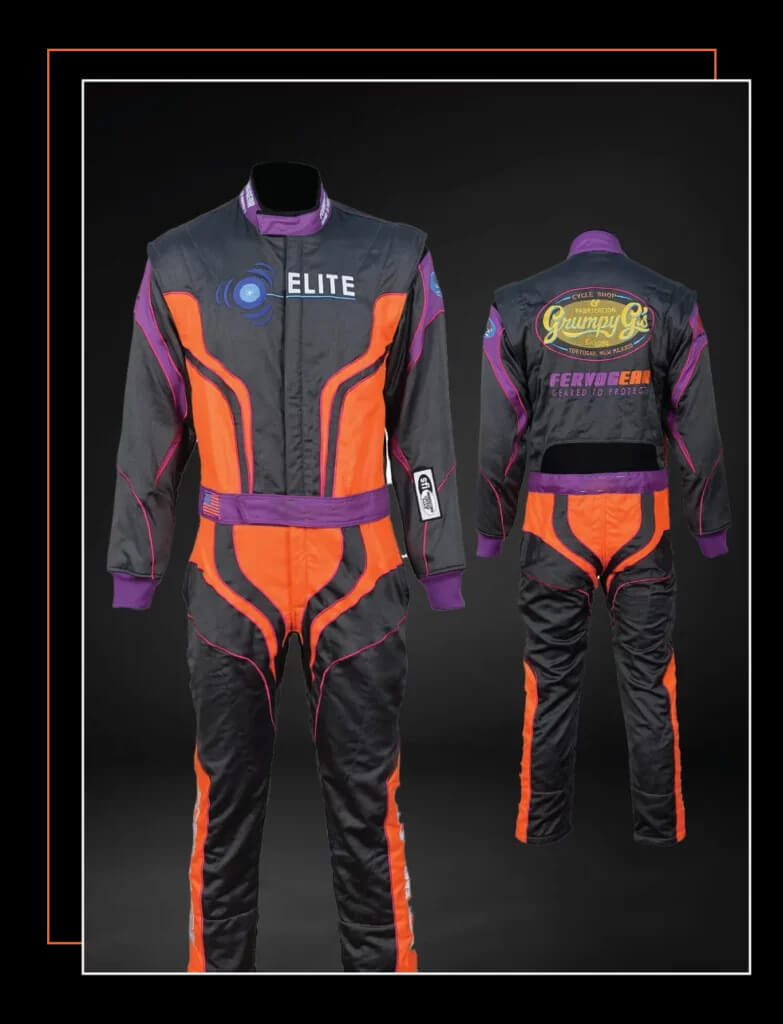
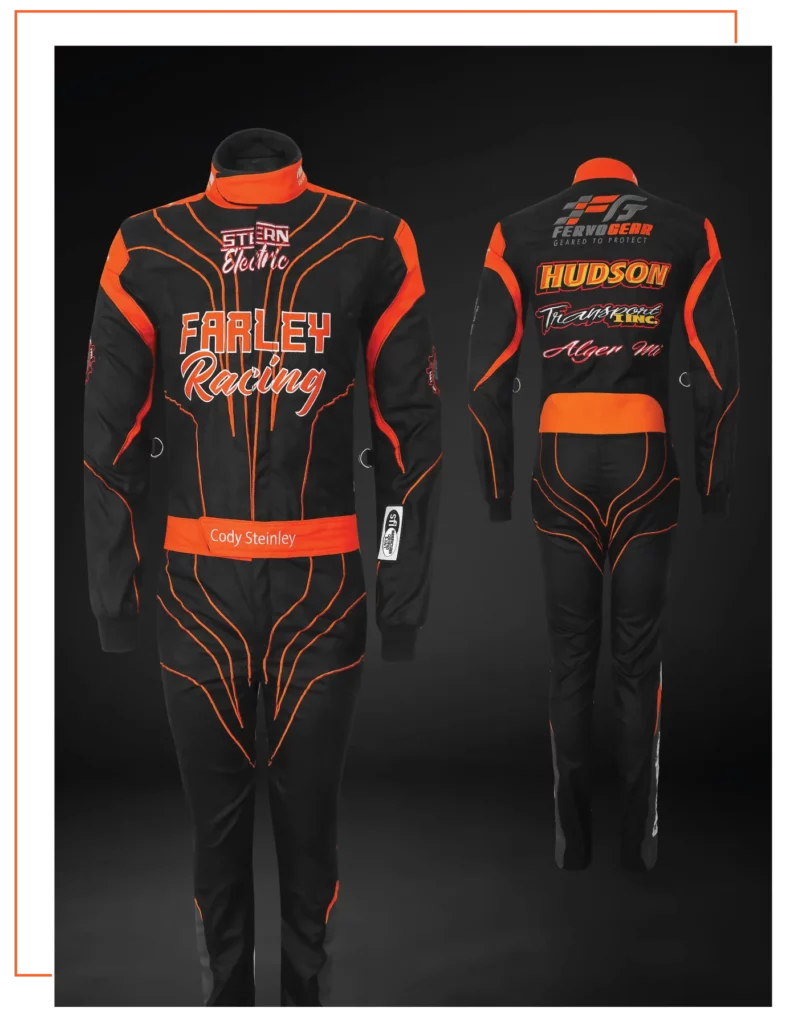
Every certified suit starts its recert clock on the date on its tag — so the real advantage of a new custom build is that you begin the full window fresh, not the tail end of someone else’s. We make every FervoGear suit to the SFI 3.2A standard, with the most-ordered spec independently certified at 3.2A/5 (double-layer Nomex®, ~10 seconds of protection).
You get a sewn-in SFI tag a tech inspector can verify, a suit cut to your current measurements, and a free design mockup before anything is built.
Custom SFI-5 race suits →Everything above is the framework — these are the edge-case questions racers ask once they’ve found the tag.
Race suit expiry questions
Do race suits actually expire?
How long is an SFI race suit good for?
Where do I find the date on my race suit?
Can I recertify an old race suit, or do I have to buy a new one?
Does washing or storing a suit affect when it expires?
Is an out-of-date suit automatically illegal?
Do FIA and SFI suits expire the same way?
Does a brand-new custom suit come with a recertification clock too?
Want a suit that starts a clean window? Start with custom SFI-5 race suits →
Tag expired? Start a fresh window
Skip the recert gamble on an old suit — see your exact design in 3–24 hours and get a newly certified SFI 3.2A/5 suit, built in 3.5 weeks.