SFI Ratings Explained — 3.2A/1 to 3.2A/20
An SFI rating is the SFI Foundation’s thermal-protective standard for racewear. On a driver suit it reads as SFI 3.2A/N — “3.2A” names the single-piece suit test method, and the number after it is the TPP (Thermal Protective Performance) level: roughly the seconds of protection before a second-degree burn. So a 3.2A/1 protects for about 3 seconds, a 3.2A/5 about 10 seconds, and a 3.2A/20 about 40 seconds.
This guide explains what the number means, how the SFI fire test certifies each level, how seconds map to layers, which rating your series requires, how SFI compares to FIA 8856-2018, and how it all applies to a custom race suit built to your design.
- The number = TPP seconds-to-burn, not a quality score
- 3.2A/5 is the rating most auto racing requires
- Your rulebook names the exact level tech checks
The Number = Seconds
TPP time before a burn
3.2A = The Standard
SFI Foundation tested
/5 ≈ 10 Seconds
Most auto racing
Rulebook Wins
Always tech-legal
SFI 3.2A ratings table — /1 to /20
The SFI 3.2A scale runs from /1 to /20, and each step buys more seconds of fire protection. Below is every level, the layer build behind it, the seconds it withstands, and the racing it’s built for.
| SFI rating | Layers | ≈ Protection | Typical use / series |
|---|---|---|---|
| 3.2A/1 | Single layer | ~3 sec | Karting & entry-level — autocross, HPDE track days |
| 3.2A/3 | 1–2 layers | ~6 sec | Quick-entry oval & some club road racing |
| 3.2A/5 | Double layer | ~10 sec | Most auto racing — dirt, circle, road, sealed-tube |
| 3.2A/10 | Multi-layer | ~19 sec | Faster oval & door-slammer drag classes |
| 3.2A/15 | Multi-layer | ~30 sec | Drag — fast bracket, alcohol & nitrous cars |
| 3.2A/20 | Multi-layer | ~40 sec | Top-fuel & nitro funny car — highest 3.2A level |
Seconds are TPP estimates — the binding requirement is whatever your series rulebook prints.
What the number after 3.2A means
The number is the TPP level — the seconds of heat the suit withstands before a wearer would take a second-degree burn. “3.2A” identifies the test method (the SFI spec for a one-piece driver suit); the slash value is the measured result. Each point on the scale is roughly one extra second of margin to escape a fire.
Higher is not automatically better. More seconds means more layers — and a heavier, hotter, stiffer suit. The goal is to match your discipline, not to max the number: a 3.2A/5 is the sweet spot for most auto racing, while only nitro and top-fuel drag genuinely need 3.2A/20. The rating is rated by the test, not by marketing.
What is Nomex →Fire test: a direct flame is held to an SFI 3.2A Nomex® panel — the shell darkens and chars in place but never burns through or melts, the behavior an SFI lab measures into a seconds-to-burn rating.
How SFI testing works
SFI 3.2A certifies a suit with a controlled flame/TPP test that measures how long heat takes to pass through the fabric — the result becomes the seconds-to-burn number stamped on the tag. But the rating covers the whole garment, not one swatch: thread, zipper and shrinkage all have to pass.
- Flame & TPP — a sample faces a calibrated flame while sensors measure heat throughput; the TPP value converts to the “/N” seconds.
- Thread & zipper heat resistance — Nomex® thread and the main zipper must survive the same heat, because a suit is only as strong as its seams.
- Thermal shrinkage — fabric can’t melt, char or shrink past strict limits, so coverage and air gaps hold during a fire.
Every SFI 3.2A rating earns its number across four checks — the lab tests the fabric, the seams and the way the whole suit behaves in heat, then audits production over time.
Flame & TPP test
A fabric sample is exposed to a calibrated flame while sensors measure heat passing through. The TPP (Thermal Protective Performance) result is converted to the seconds-to-burn number that becomes the “/N” rating.
Thread & zipper heat resistance
Nomex® thread, the main zipper and trim must survive the same heat — a suit is only as strong as its seams, so SFI 3.2A certifies the whole garment, not just the panel fabric.
Thermal shrinkage
Fabric is heated and measured: it must not shrink, melt or char beyond strict limits, so the suit keeps its protective air gaps and full coverage during a fire rather than tightening against the skin.
Tag, audit & re-test
A passing build earns a sewn-in SFI 3.2A tag with a date. SFI audits production samples on an ongoing cycle, so the rating reflects what leaves the line — not just one lab coupon.
The Nomex® fiber is what makes those numbers possible — what is Nomex →
Each SFI level in depth
The four reference levels — /1, /5, /15 and /20 — span the full range from karting to nitro. Here’s who each rating is for, the layers it’s built from, and the seconds it buys you.
The lightest, coolest, most flexible certified suit. One layer of Nomex® gives roughly 3 seconds of margin — enough for low-speed, low-fire-risk classes where FR underwear backs it up.
The workhorse rating. Two Nomex® layers trap an insulating air gap and roughly triple the protection to ~10 seconds — the level the broad middle of auto racing writes into the rulebook.
A multi-layer build for fast drag classes. Extra Nomex® and quilted insulation push protection to ~30 seconds, because a methanol or nitrous fire burns hotter and a stuck car takes longer to exit.
The top of the 3.2A scale. Heavy multi-layer construction delivers ~40 seconds of protection for the highest-energy nitromethane fires — the suits worn by top-fuel and nitro funny car drivers.
Seconds of protection before a second-degree burn
TPP estimate · 0 → 40 secondsMore seconds always means more layers, more weight and more heat for the driver. The chart is why matching the rating to your discipline beats chasing the biggest number — a circle-track car gains nothing from /20 it can’t use.
What SFI rating does my series require?
Your series rulebook is the only authority — it prints the exact rating tech will check. This map by discipline shows the typical requirement and example sanctioning bodies, so you know where to look before you order.
| Discipline | Typical SFI rating | Example sanctioning bodies |
|---|---|---|
| Dirt & circle trackLate-model, modified and sprint sanctions almost always write a double-layer requirement. | 3.2A/5 | IMCA · USRA · WISSOTA · USAC |
| Road & sports-car (club → pro)Slower run groups accept single-layer; move up and 3.2A/5 plus FR underwear becomes the norm. | 3.2A/1 → 3.2A/5 | SCCA · NASA · regional clubs |
| Drag — bracket & sportsmanThe number climbs with ET: faster cars and power-adders demand more layers and seconds. | 3.2A/5 → 3.2A/15 | NHRA · IHRA · PDRA |
| Drag — alcohol, nitrous & nitroTop-tier classes require the highest 3.2A levels because nitro fires are the hottest in racing. | 3.2A/15 → 3.2A/20 | NHRA pro · top-fuel · funny car |
| Karting & track daysPure karting and casual HPDE commonly allow single-layer — but supplementary regs can demand more. | 3.2A/1 | Local karting · HPDE organizers |
When a class lists no number, default to 3.2A/5 — it’s legal across the widest range of auto racing.
Dirt & circle track
Late-model, modified and sprint sanctions almost always require a double-layer 3.2A/5. Use it as your default if your class lists no number.
Road & sports-car
Club road racing accepts 3.2A/1 for slower run groups and steps up to 3.2A/5 plus FR underwear in faster and endurance classes.
Drag racing
The one discipline where the number climbs fast — quicker ETs and power-adders move you from 3.2A/5 to 3.2A/15 or 3.2A/20.

SFI vs FIA 8856-2018
SFI 3.2A and FIA 8856-2018 are two different fire-protection standards, and your rulebook decides which one certifies your suit. SFI 3.2A is the US standard from the SFI Foundation, written into most American grassroots and pro series and graded /1 to /20. FIA 8856-2018 is the international homologation used at FIA-sanctioned and many pro road-racing events.
Some series accept either standard; others name one specifically. A suit can be built to satisfy both, but the legal test at the gate is the exact standard your regs print — never assume one substitutes for the other.
Best custom race suit brands →Do SFI suits expire?
The certification expires, not the suit. SFI 3.2A tags carry a date, and most sanctioning bodies expect re-certification about every 5 years — the suit goes back to an SFI-recognized facility for inspection and a fresh tag.
A clean, well-stored suit usually passes and keeps racing. But a tech inspector can reject an out-of-date tag at the gate, so confirm your series’ recert window before each season — it’s the detail that ends a race day before it starts.
How to measure for a race suit →How the layer count earns the rating
The rating is earned by layers: each Nomex® layer adds an insulating air gap, and that gap slows heat far more than the fabric alone. A single-layer 3.2A/1 holds ~3 seconds; add a second layer with a trapped air gap and a 3.2A/5 reaches ~10 seconds — more than triple, from one more layer.
That’s why layer count, not brand name, drives the seconds. Multi-layer builds stack further insulation to reach the 3.2A/15 and 3.2A/20 levels nitro racing demands — at the cost of weight and heat.
Single vs double layer race suit →Double-layer cross-section (3.2A/5)
How this applies to your custom suit
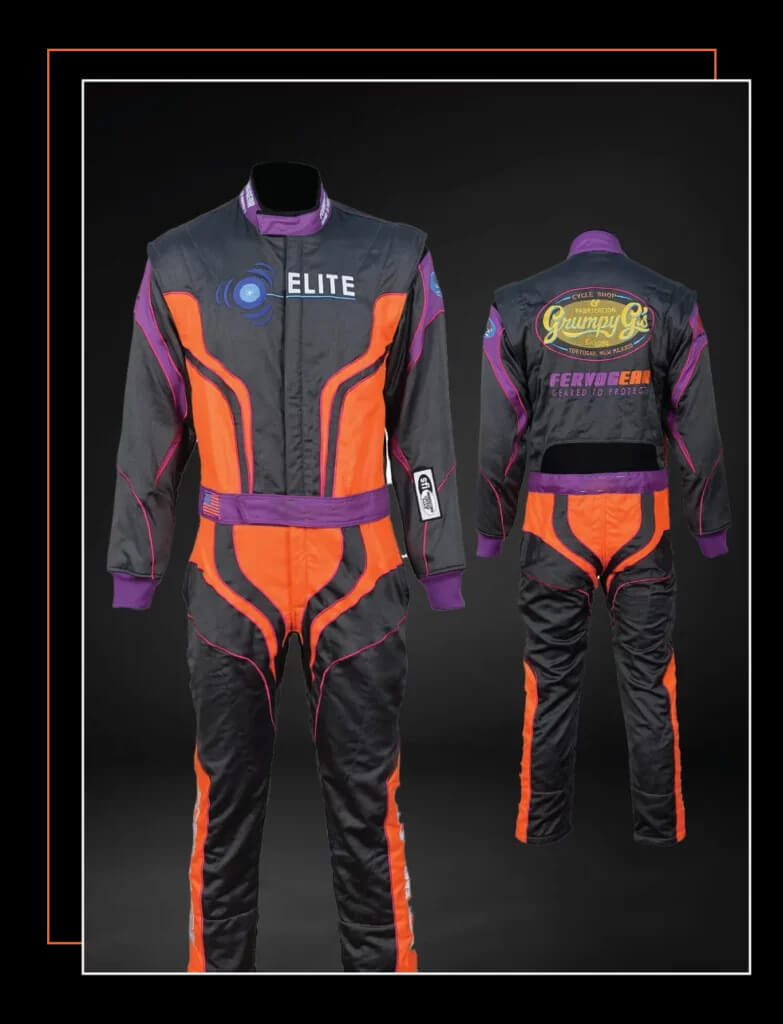
Once you know your number, the build follows. We make every FervoGear suit to the SFI 3.2A standard, with the most-ordered spec independently certified at 3.2A/5 — double-layer Nomex®, ~10 seconds of protection, the rating most series require — cut to your exact measurements and your design.
You get a sewn-in SFI tag a tech inspector can verify, plus a free design mockup before anything is built.
Custom SFI-5 race suits →Everything above is the framework — these are the edge-case questions racers ask once they’ve picked a number.
SFI ratings questions
What does the number after 3.2A mean?
Is a higher SFI rating always better?
Is SFI the same as FIA?
How is an SFI rating tested?
Do SFI suits expire?
Which SFI rating do I actually need?
Why does a double-layer suit earn a higher rating than a single-layer one?
Does the SFI rating cover gloves, shoes and underwear?
Are FervoGear custom suits SFI certified?
Still mapping your spec? Start with how to measure for a race suit →
Get the right SFI rating, built to your design
Tell us your series and we’ll spec the certified suit it requires — see your exact design in 3–24 hours, built in 3.5 weeks.