SFI vs FIA 8856-2018 — Which Standard Do You Need?
SFI 3.2A and FIA 8856-2018 are the two race-suit fire standards, and your series rulebook decides which one your suit must carry. SFI 3.2A is the US standard from the SFI Foundation, graded /1 to /20 by a TPP seconds-to-burn test. FIA 8856-2018 is the international homologation from the FIA, judged by an HTI (Heat Transfer Index) test as a single pass with no sub-levels.
This guide defines each standard, sets them side by side, shows how the TPP and HTI tests differ, maps which racing requires which, answers whether one suit can hold both, and explains how it all applies to a custom race suit built to your design.
- US oval, dirt & drag run on SFI 3.2A
- International & pro road racing require FIA 8856-2018
- One suit can be built to pass both standards
 SFI vs FIA
SFI = US Standard
SFI Foundation · /1–/20
FIA = International
8856-2018 homologation
TPP vs HTI
Two different fire tests
Rulebook Decides
It names the exact one
What is SFI 3.2A?
SFI 3.2A is the US race-suit fire standard set by the SFI Foundation, graded from /1 to /20 by a TPP (Thermal Protective Performance) test. The “3.2A” names the single-piece driver-suit spec; the number after the slash is the measured level — roughly the seconds of heat the suit withstands before a second-degree burn. A 3.2A/1 holds ~3 seconds, a 3.2A/5 ~10 seconds, and a 3.2A/20 ~40 seconds.
SFI 3.2A is the standard written into most American grassroots and professional series — NHRA drag, IMCA dirt, USAC oval and the broad middle of US club racing. Because it is graded, a racer can match the exact protection a class requires rather than over-buying. A sewn-in, dated SFI tag is what tech inspectors verify at the gate.
SFI ratings explained →What an SFI 3.2A tag tells you
What an FIA 8856-2018 tag tells you
What is FIA 8856-2018?
FIA 8856-2018 is the FIA’s international homologation standard for flame-resistant racewear, judged by an HTI (Heat Transfer Index) test as a single homologated pass. Unlike SFI, it has no numbered levels — a suit either holds the 8856-2018 homologation or it doesn’t. The 2018 revision replaced the earlier FIA 8856-2000 standard with an updated test protocol and homologation paperwork.
FIA 8856-2018 is the global benchmark required at FIA-sanctioned events and most professional road racing — Formula 1, WEC, WRC and pro GT grids all write it into their regulations. Because each suit needs full FIA homologation, the standard is stricter on paperwork and typically costs more than an equivalent SFI build.
What is Nomex →SFI 3.2A vs FIA 8856-2018 — side by side
The two standards differ in body, test method, grading, region and cost — but both certify the same goal: fire protection. This table sets every dimension side by side so you can see exactly what separates them before you order.
| Dimension | SFI 3.2A | FIA 8856-2018 |
|---|---|---|
| Issuing body | SFI Foundation (USA) | FIA — Fédération Internationale de l’Automobile |
| Spec name | SFI 3.2A/N (driver suit) | FIA 8856-2018 (replaced 8856-2000) |
| Heat test | TPP — seconds-to-burn through the fabric | HTI — Heat Transfer Index, two thresholds (HTI24 & HTI12) |
| Graded levels | Numbered /1 to /20 | Single homologated pass — no sub-levels |
| Primary regions | US oval, dirt, drag & most grassroots | International, FIA-sanctioned & most pro road racing |
| Typical cost | Lower — broad grassroots availability | Higher — homologation & limited makers |
| Who requires it | NHRA, IMCA, USAC, most US club series | FIA championships, many pro road & GT series |
The table is the framework — the binding requirement is always the exact standard your series rulebook prints.
How the tests differ — TPP vs HTI
SFI grades a suit by TPP seconds-to-burn; FIA homologates it by the HTI heat-transfer thresholds. Both measure how long the fabric holds back heat — but they report the result differently, which is why you can’t translate an SFI level directly into an FIA number.
A fabric sample faces a calibrated flame while sensors measure the heat passing through. The TPP value is converted into a seconds-to-burn number, which becomes the graded “/N” level — so the result is a scale a racer reads directly.
The HTI test times how long heat takes to raise the inside surface by set temperature thresholds — HTI24 and HTI12. The suit must clear both to earn homologation, so the result is a single pass / fail rather than a numbered scale.
Different methods · same purpose · not interchangeable on paper
Both tests reward the same thing — more Nomex® layers and trapped air gaps. single vs double layer race suit →
Which series require which standard?
US oval, dirt and drag racing run on SFI 3.2A; international, FIA-sanctioned and most pro road racing require FIA 8856-2018. This map by discipline shows the standard each typically writes into its rulebook and example sanctioning bodies, so you know where to look before you order.
| Discipline | Required standard | Example sanctioning bodies |
|---|---|---|
| US drag racingNHRA and IHRA write SFI levels by ET — /5 up to /20 for nitro. | SFI 3.2A | NHRA · IHRA · PDRA |
| US oval, dirt & circleLate-model, modified and sprint sanctions name a double-layer SFI suit. | SFI 3.2A/5 | IMCA · USAC · WISSOTA |
| International / FIA championshipsWorld and continental FIA series homologate the suit to 8856-2018. | FIA 8856-2018 | F1 · WRC · WEC · F2/F3 |
| Pro road & GT racingMost professional sports-car and GT grids require FIA homologation. | FIA 8856-2018 | IMSA pro · GT World · Le Mans |
| US club road racingClub road bodies name SFI but accept a current FIA suit as equivalent. | SFI 3.2A — FIA accepted | SCCA · NASA |
When a US class lists no standard, default to SFI 3.2A/5 — it’s legal across the widest range of American racing.
US drag, oval & dirt
NHRA, IMCA and USAC name SFI 3.2A — the level climbs with speed, from /5 up to /20 for nitro classes.
International & pro road
FIA championships and most professional sports-car grids require FIA 8856-2018 homologation, not SFI.
US club road racing
SCCA and NASA name SFI 3.2A but accept a current FIA suit as equivalent — handy if you race both.
Fire test: a direct flame on a Nomex® suit panel — the same flame resistance both the SFI TPP and FIA HTI tests measure, just by different methods. The shell chars but never burns through.
Can a suit hold both?
Yes — a suit can be independently tested to pass both SFI 3.2A and FIA 8856-2018, and it then carries both tags. Dual certification lets one garment race US series and international events, which is why premium suits often hold both homologations. The trade-off is cost: two separate tests and two sets of paperwork.
- One suit, two tags — built and tested to satisfy both the TPP and HTI methods, so it’s legal on either side of the gate.
- Higher cost — dual homologation adds price, so only buy both if you actually race under both standards.
- Never assume — an SFI-only suit will not pass FIA tech, and one tag never automatically substitutes for the other.
How to read the labels
Every certified suit carries a sewn-in tag, and the code on it tells you exactly which standard the suit passed. An SFI 3.2A/N tag names the test method and the graded level; an FIA 8856-2018 tag names the homologation. Both also carry a date that decides how long the certification stays valid.
Watch for the FIA 8856-2000 tag — it’s the older standard, still seen on used suits but no longer accepted by some series. If your tag reads 8856-2000, confirm your championship still recognizes it. A tech inspector reads these tags before every event, so the label, not the brand name, is what makes a suit legal.
How to measure for a race suit →The codes you’ll see on a cert tag
How this applies to your custom suit
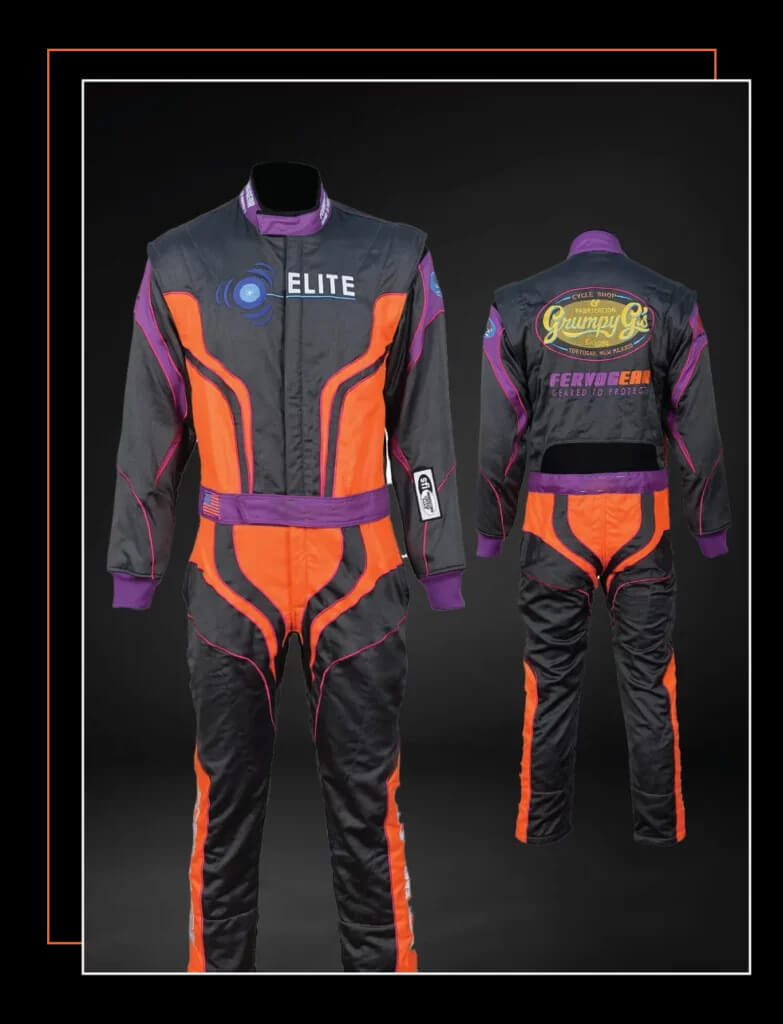
Once you know which standard your series names, the build follows. We make every FervoGear suit to the SFI 3.2A standard, with the most-ordered spec independently certified at 3.2A/5 — double-layer Nomex®, ~10 seconds of protection, the rating US oval, dirt, drag and club road racing require — cut to your exact measurements and your design.
Racing an international or pro road series that requires FIA 8856-2018? Tell us your championship when you request your free mockup and we’ll spec the suit to the standard your rulebook names. Either way you get a sewn-in tag a tech inspector can verify, plus a free design preview before anything is built.
Custom SFI-5 race suits →Everything above is the framework — these are the edge-case questions racers ask once they know which standard they need.
SFI vs FIA questions
What is the difference between SFI and FIA?
Is FIA better than SFI?
Can one suit be both SFI and FIA certified?
Which standard do I need — SFI or FIA?
What is the difference between FIA 8856-2018 and 8856-2000?
Does FIA use the same seconds-to-burn test as SFI?
Will a US SFI suit pass tech at an international event?
Are FervoGear custom suits SFI or FIA certified?
Still mapping your spec? Start with SFI ratings explained →
Get the right standard, built to your design
Tell us your series and we’ll spec the certified suit it requires — SFI 3.2A or FIA 8856-2018 — see your exact design in 3–24 hours, built in 3.5 weeks.