What SFI Rating Do I Need? (By Racing Series)
For most auto racing you need SFI 3.2A/5 — a double-layer suit rated for about 10 seconds of fire protection. Karting and casual track days commonly use SFI 3.2A/1 (single layer, ~3 seconds), and only fast drag classes climb to 3.2A/15 or 3.2A/20. The number after “3.2A” is the seconds of protection, not a quality score.
The rating you actually need is whatever your series rulebook prints for your class. This guide gives the quick answer, the series-by-series map (dirt, drag, road, karting), and how it all applies to a custom race suit built to your design.
- Most racing = 3.2A/5 · karting = 3.2A/1 · nitro drag = 3.2A/20
- Your rulebook names the exact level tech checks
- Higher isn’t “better” — match the rating to your discipline
Most Racing = /5
Double-layer baseline
Karting = /1
Single layer or non-SFI
Nitro = /20
Only fast drag climbs
Rulebook Wins
Always tech-legal
The quick answer — three rating buckets
Almost every racer falls into one of three buckets, and each maps to one SFI rating. Find the bucket that matches your racing, then confirm the exact number in your rulebook before you order.
Karting suits are usually non-SFI (abrasion-rated) for recreation; SFI 3.2A/1 single-layer Nomex® is for entry-level auto racing where a rulebook requires it. Light, cool, flexible.
Double-layer Nomex®, ~10 seconds of protection. The rating the broad middle of dirt, circle, road and bracket racing requires.
Multi-layer builds for alcohol, nitrous and nitro cars — the only place the number routinely climbs this high.
New to the numbers? See SFI ratings explained — 3.2A/1 to 3.2A/20 →
How to find your required rating
No website outranks your series rulebook — it prints the exact SFI 3.2A/N tech will check at the gate. Here’s exactly where to look and how to read it, in four steps.
Open your series rulebook
The sanctioning body’s current-year rulebook is the only authority. Find the “Driver Apparel,” “Safety Equipment” or “Personal Equipment” section — that’s where the required SFI 3.2A/N is printed for your class.
Match it to your exact class
Ratings change by class, not just by series. A bracket car and an alcohol car under the same drag sanction need different numbers, so read the line for your specific class — not the series average.
Check supplementary & track regs
A local track or event can require more than the national rulebook. Read any track supplemental regs and series bulletins; the stricter rule always wins at the gate.
Default to 3.2A/5 if no number is listed
When a class lists fire gear but no SFI level, a double-layer 3.2A/5 is the safest default — it’s legal across the widest range of auto racing and rarely under-specs you.
Ratings change by class, not just by series — always read the line for your exact class.
SFI rating by racing series
This table maps every common discipline to the SFI rating its rulebooks typically require, with example sanctioning bodies. It’s a starting point to know where you sit — the binding number is whatever your class line prints.
| Discipline / series | Typical SFI rating | ≈ Protection | Example sanctioning bodies |
|---|---|---|---|
| Dirt & circle trackLate-model, modified and sprint sanctions almost always write a double-layer minimum. | 3.2A/5 | ~10 sec | IMCA · USRA · WISSOTA · USAC |
| Asphalt late model & stockPavement oval classes follow the same double-layer baseline as dirt. | 3.2A/5 | ~10 sec | IMCA · ASA · track-level rules |
| Drag — bracket & sportsmanSlower-ET bracket and street-class cars use the /5 baseline. | 3.2A/5 | ~10 sec | NHRA · IHRA · PDRA |
| Drag — alcohol & nitrousPower-adders and quicker ETs climb the scale to a multi-layer build. | 3.2A/15 | ~30 sec | NHRA · IHRA · PDRA |
| Drag — top-fuel & nitro funny carThe hottest fires in racing demand the highest 3.2A level. | 3.2A/20 | ~40 sec | NHRA professional |
| Road, club & HPDESlower groups accept single-layer; wheel-to-wheel and pro classes want /5. | 3.2A/1 → 3.2A/5 | ~3–10 sec | SCCA · NASA · regional clubs |
| KartingKarting suits are usually non-SFI (abrasion-rated) for recreation; SFI 3.2A/1 is for entry-level auto racing where required. Sprint enduro may want SFI. | 3.2A/1 or non-SFI | ~3 sec | WKA · local & regional karting |
When a class lists fire gear but no number, default to 3.2A/5 — it’s legal across the widest range of auto racing.
Dirt, circle & late model
IMCA, USRA, WISSOTA and most asphalt oval rules write a double-layer 3.2A/5 minimum — use it as your default if your class lists no number.
Drag — bracket to nitro
NHRA, IHRA and PDRA scale by ET: bracket cars run 3.2A/5, alcohol & nitrous step to 3.2A/15, and top-fuel needs 3.2A/20.
Road, club, HPDE & karting
SCCA and NASA accept 3.2A/1 for slower groups and want 3.2A/5 for wheel-to-wheel; WKA karting often allows abrasion-rated suits.
Why a higher rating isn’t always better
Every step up the SFI scale buys seconds — and costs comfort. More protection means more Nomex® layers, which means more weight, more trapped heat and less flexibility. For most auto racing a 3.2A/5 is the balance point: enough protection for the rulebook, light enough to drive a full stint.
Over-rating your suit doesn’t make you safer for your discipline — it makes you hotter and more fatigued for protection you’ll never use. A circle-track car gains nothing from a 3.2A/20 built for nitromethane fires. Meet your number, then spend on fit and quality, not on seconds you can’t use.
Single vs double layer race suit →Protection vs comfort, by rating
Higher rating · more seconds · less comfortAs the rating climbs, protection rises and wearable comfort falls. The 3.2A/5 band is where most racers sit — the most seconds you can carry without cooking yourself in the car.
Fire test: watch a direct flame meet an SFI-rated Nomex® suit panel — it chars and self-extinguishes instead of burning through, which is exactly the protection tech inspectors verify by the sewn-in SFI tag.
What happens at tech inspection
Tech inspection is where your rating gets verified — an inspector reads the sewn-in SFI 3.2A tag against your class requirement and checks the date. Get the number wrong and the day can end before you run, so the right rating is a pass/fail detail, not a preference.
- Tag & level — the inspector confirms a sewn-in SFI 3.2A/N tag that meets or exceeds your class’s required level.
- Date & recert — an expired or undated tag can fail; most series expect recertification roughly every 5 years.
- Matching gear — gloves, shoes and FR underwear are often checked against their own SFI 3.3 specs at the same time.
Single vs double layer for your rating
The layer count is what earns the rating: a single-layer suit certifies to 3.2A/1 (~3 seconds), and a second Nomex® layer with a trapped air gap pushes it to 3.2A/5 (~10 seconds). So when your series asks for 3.2A/5, it’s asking for a double-layer build — not a single layer with a bigger label.
If your rulebook lists 3.2A/1, a single layer plus SFI 3.3 FR underwear usually satisfies it. If it lists 3.2A/5 or higher, you need the layers to match — there’s no shortcut to the seconds.
Single vs double layer race suit →Double-layer cross-section (3.2A/5)
Matching your gloves & shoes ratings
Your suit is rated SFI 3.2A; your gloves, shoes and FR underwear use the separate SFI 3.3 accessory spec. Most rulebooks want them at or near your suit’s level, so spec the whole kit together — not just the suit.
Driving gloves carry the SFI 3.3 accessory spec, graded /1 to /5 like the suit scale. Most rulebooks want gloves at or near your suit’s level.
Racing shoes also fall under SFI 3.3. A single tag covers the boot; match the level your series lists alongside the suit requirement.
With a single-layer 3.2A/1 suit, most rulebooks require SFI 3.3 FR underwear underneath to reach an equivalent total protection level.
A single-layer 3.2A/1 suit usually needs SFI 3.3 FR underwear under it to reach an equivalent level of protection.
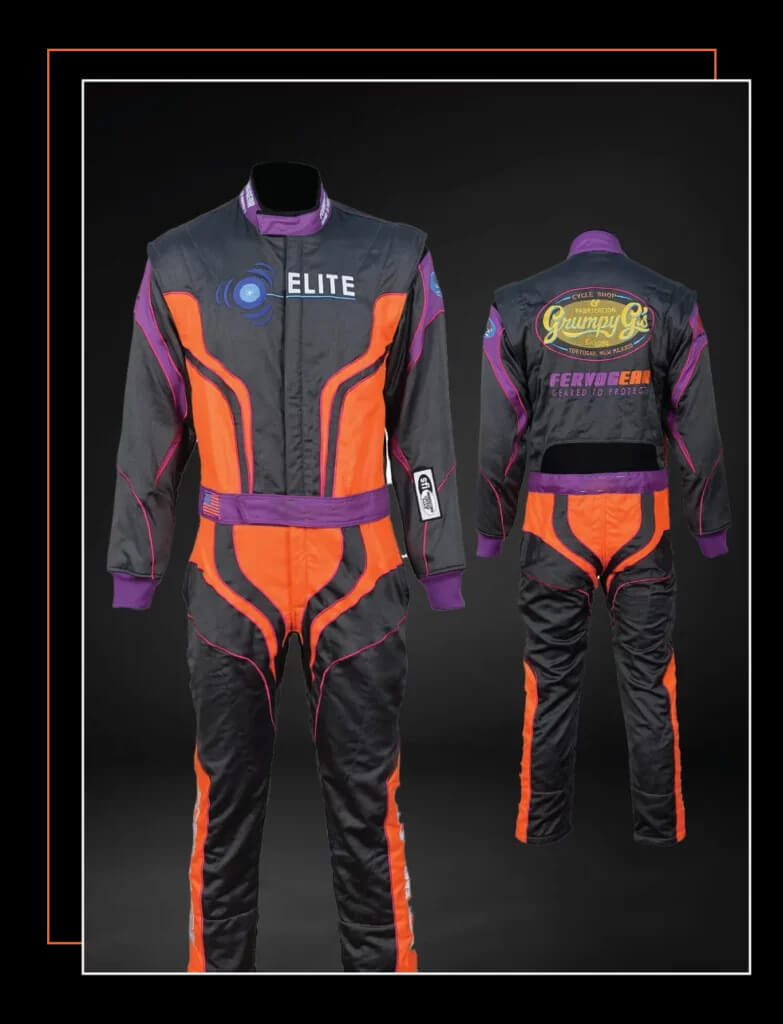
How this applies to your custom suit
Once you know your number, the build follows. We make every FervoGear suit to the SFI 3.2A standard and spec it to your series — single-layer 3.2A/1 for karting and track days, or the most-ordered 3.2A/5 (double-layer Nomex®, ~10 seconds) that the broad middle of auto racing requires — cut to your exact measurements and your design.
You get a sewn-in SFI tag a tech inspector can verify, plus a free design mockup before anything is built.
Custom SFI-5 race suits →From dirt ovals to drag strips, FervoGear suits are specced to the rating each series requires — and tailored to each driver.
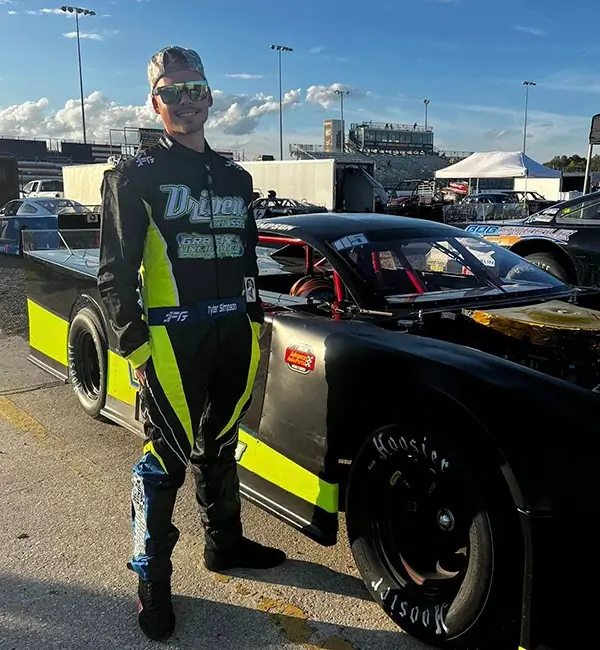
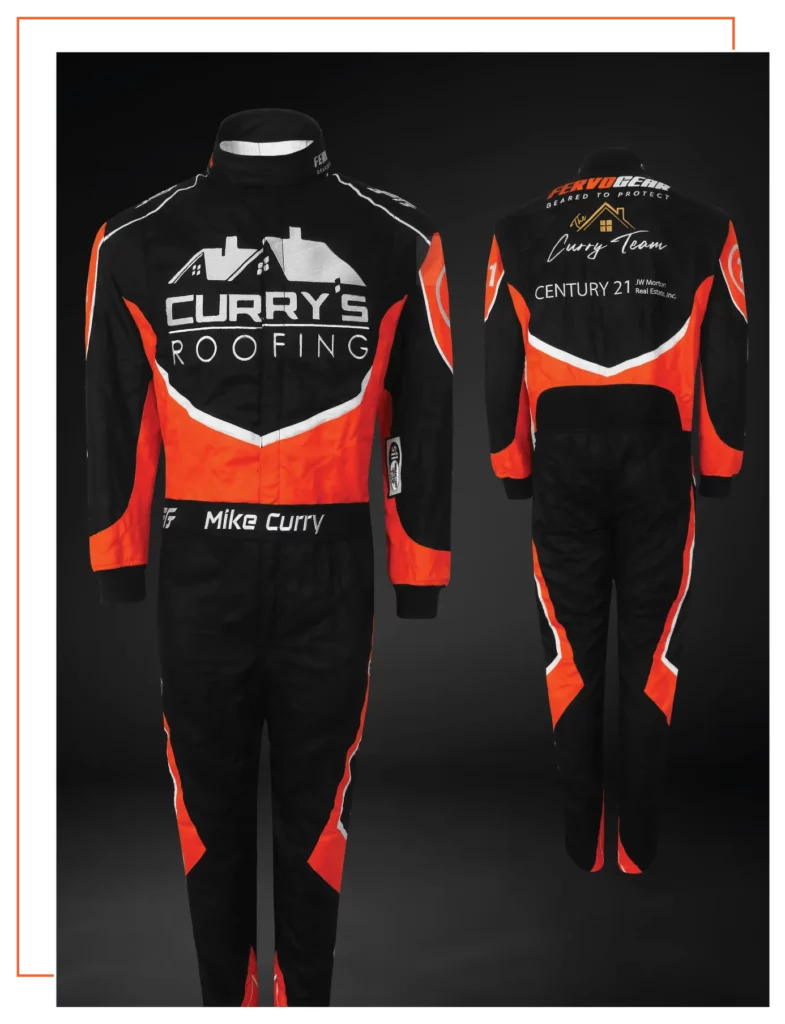
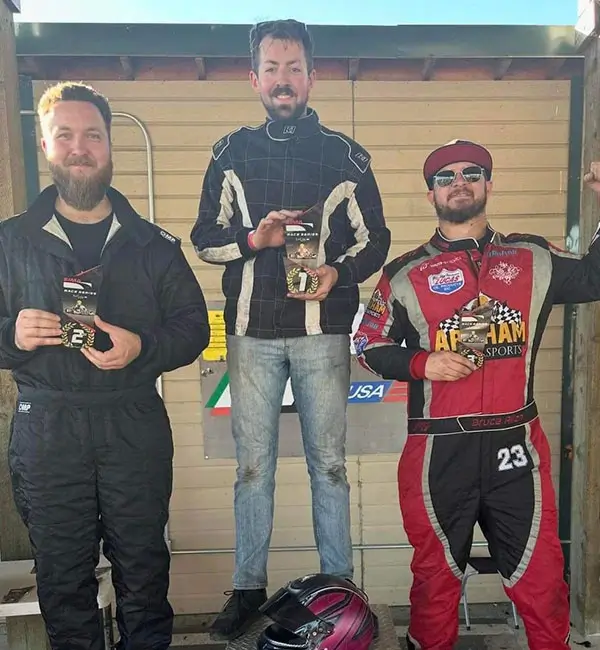
Everything above is the framework — these are the edge-case questions racers ask once they’ve narrowed their rating.
SFI rating questions
What SFI rating do I need for most racing?
What SFI rating do I need for karting?
Do I need a higher SFI rating than my series lists?
What SFI rating do I need for drag racing?
What happens at tech inspection if my rating is wrong?
Is SFI the same as the FIA rating I need?
Do my gloves and shoes need to match my suit’s SFI rating?
What SFI rating does FervoGear build to for my series?
Want the full scale behind these numbers? Read SFI ratings explained →
Tell us your series — we’ll spec the rating
Give us your series and class and we’ll spec the certified SFI suit it requires — see your exact design in 3–24 hours, built in 3.5 weeks.